Is It Too Late to Fix My Posture? The Truth About Age, Tissue, and Change
Dear reader who just turned fifty-five and found this site at midnight,
No. It is not too late.
I know why you are here at this hour. You looked in the mirror, or someone took a photo from the side, or you could not turn your head far enough to merge on the highway. Something made the trajectory visible. And you typed the question into the search bar that you have been carrying for years.
Let me give you the biology first. Then the harder truth.
What the Tissue Can Do
Bone responds to load at any age. Wolff’s Law, established in the nineteenth century, confirmed by every study since: bone remodels along lines of mechanical stress. Apply new forces, and the bone adapts. The rate decreases with age. The capacity does not. Astronauts lose bone density in microgravity and regain it when they return to Earth. The tissue responds regardless of the calendar.
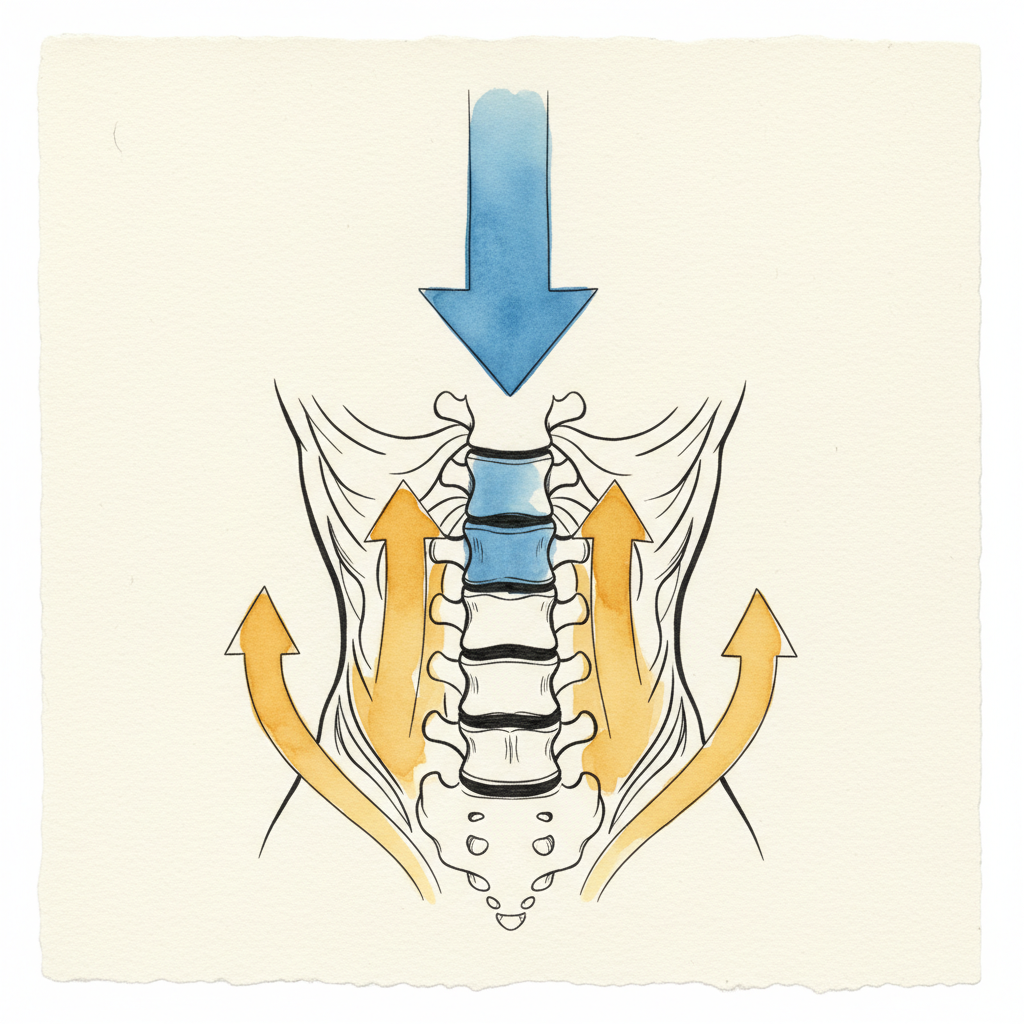
Fascia responds to tension at any age. Davis’s Law: soft tissue remodels along lines of imposed demand. Collagen fibers reorganize in response to the forces placed upon them. Slower in older tissue because collagen turnover rates decrease. But slower is not stopped. The fascia of a sixty-year-old is less responsive than that of a thirty-year-old. It is not unresponsive.
The nervous system remains plastic across the lifespan. The body schema, the deep map that generates posture, can update at any age. The thalamic gating, the sensory processing, the cerebellar integration. All capable of change. The speed decreases. The possibility persists.
What changes with age is the speed of remodeling. Not the capacity.
Why the Curve Progresses
If you have scoliosis, you may have been told that curves greater than thirty degrees at skeletal maturity tend to progress approximately one degree per year. This is the statistical average. It is not a sentence.
The conventional explanation is gravitational: asymmetrical spine, gravity pulls it further. Disc degeneration on the concave side accelerates asymmetry. Vertebral bodies wedge. Curve deepens.
This describes what happens. It does not explain why some forty-year-olds with thirty-degree curves are stable while others with the same measurement are progressing rapidly.
The missing variable is the nervous system. The curve is a pattern being actively maintained by the body schema’s prediction. When sensory data degrades over time, when vision narrows, breathing shallows, ground contact diminishes, stress chronifies, the prediction worsens. The model entrenches. Progression is not inevitable. The curve progresses because the conditions for progression are maintained.
Change the conditions, and the trajectory changes.
At Forty
Forty is when most people start paying attention. The aches have accumulated. The stiffness is noticeable. The shape in the mirror has drifted far enough from the internal self-image that denial becomes difficult.
Every tissue system is fully responsive to new input at forty. Bone turnover active. Fascial remodeling robust. Neuroplasticity strong.
I started at thirty-three. An 85-degree S-curve that had been progressing for twenty years. Every specialist said surgery. Too severe. Too entrenched. Too late for conservative intervention. They were wrong. I stopped trying to force muscles into new positions and started giving the body schema new sensory evidence. The prediction updated. The pattern shifted. Not overnight. Over months and years.
At Fifty
The timeline extends. Tissue remodeling is slower. Collagen turnover takes longer. Disc degeneration may be more advanced. Real constraints that change the speed of change.
The nervous system at fifty is still plastic. The body schema can still update. Sensory inputs can still be improved.
What changes is the patience required. A degree of curve correction per year is invisible on a monthly scale. Over five years, it is significant. Over ten, it is transformative. Most people quit not because the body cannot change, but because the timeline does not match their expectations.
At Sixty and Beyond
Constraints are more significant. Osteoporosis may limit load tolerance. Stenosis may restrict mobility. Joint replacements may alter the biomechanical landscape. These are real. They must be respected.
Yola is sixty-seven. Severe S-curve, 84 to 85 degrees. She had worn a brace 23 to 24 hours a day. Rejected surgery. Built independence through self-practice. During our cohort, she described what happened when she found organized internal pressure: “I didn’t have to stay straight or feel the twist. I didn’t have to do any work. It just worked.”
Sixty-seven. Severe curve. Daily practice. Taking the work into brushing her teeth, into walking.
The goal at sixty shifts. Not from change to management. From correction to optimization. You may not achieve the range of a forty-year-old. But meaningful reduction in pain, meaningful improvement in breathing capacity, meaningful increase in functional mobility, meaningful slowing or halting of progression. These are not consolation prizes. They are the difference between a body that is declining and a body that is reorganizing.
What the Conventional Model Gets Wrong
The conventional model says: tissue becomes fixed. The window closes.
What it means is: the tools we have become less effective after skeletal maturity. Bracing, muscle-targeting exercises, surgical fusion. Mechanical tools addressing the output. Of course they lose effectiveness as the output entrenches.
The nervous system approach does not have the same age limitations because it does not address the output. It addresses the prediction that generates the output. The prediction is a neural pattern. Neural patterns change at any age.
The belief that nothing can change is itself harmful. People who believe it stop trying. People who stop trying stop providing their tissue with new input. Tissue that receives no new input consolidates its current pattern. The belief becomes self-fulfilling. Not because the body could not change. Because the person was told it could not and acted accordingly.
The Speed of Tissue
Bone remodels on a cycle of three to four months. Fascia turns over its collagen on a cycle of six to twenty-four months. The body schema consolidates new patterns over weeks to months.
None of these match the timescale of human patience.
You practice for a week and see nothing in the mirror. A month, and the measurements are the same. Three months, and the change is so gradual it is invisible without before-and-after comparison.
The tissue is changing. The prediction is updating. The remodeling is underway. But it is happening at the speed of biology, not the speed of desire.
I am forty-two. I started at thirty-three. Still changing. After nine years. The tissues that took decades to consolidate do not reorganize in months. They reorganize in years. The nervous system updates faster than the structure. The prediction shifts before the bones do. And then the structure follows, slowly, at the speed of collagen and bone.
So Here Is What I Want You to Know
You found this site at midnight because something in you is not ready to accept the trajectory. Good. That instinct is correct. The biology supports it.
The window does not close. It narrows. The light coming through is dimmer. The process takes longer. But the window is open.
The people who told you it was too late were speaking from a mechanical model that treats posture as a structural problem with a structural solution. If the structure is set, the solution is off the table. But posture is a prediction problem. Predictions change when the evidence changes. You can change the evidence at any age.
Better sensory input. Organized breathing. Restored internal pressure. Addressed vision and jaw function. Ground contact. These inputs do not have an expiration date.
The real question is not whether your body can change. It can. The question is whether you are willing to work at the speed your tissue actually moves. Weeks without visible results. Months of practice before the mirror confirms what the system already knows. Years of sustained, patient input at the speed biology dictates rather than the speed impatience demands.
Change is always available. Change is always slow. The people who transform accept both.
It is not too late.
Sam Miller is the founder of Posture Dojo. He lives inside an 85-degree S-curve and has for thirty years. He writes from the inside of that experience.
Leave a Reply