Your Nervous System Is Running Your Posture
“Wait. So my body is not broken? It is just running the wrong model?”
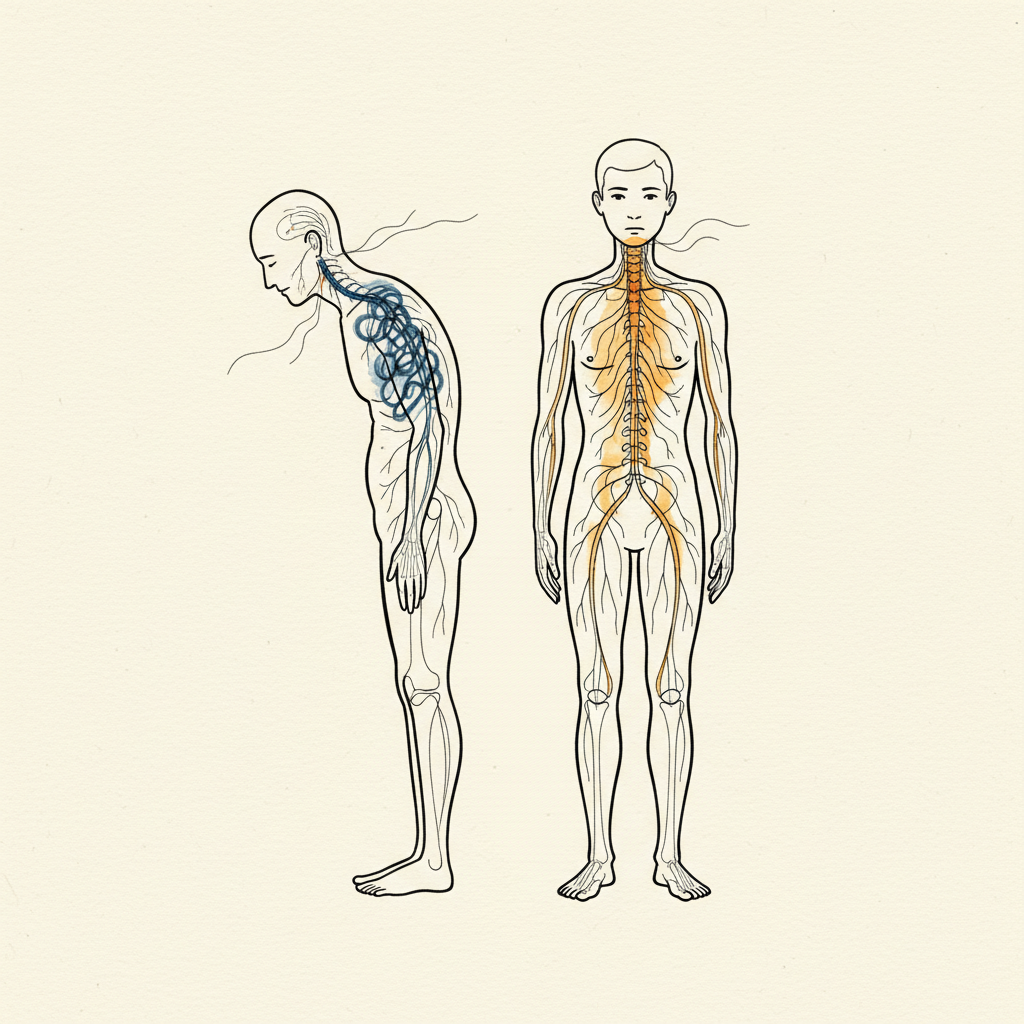
A participant said that during a live session last month. She had spent six years being told her posture was a structural problem. Weak muscles. Tight fascia. Bones in the wrong place. She had done the exercises. Seen the specialists. Nothing held.
Then she felt internal pressure organize for the first time, and her back muscles released without her doing anything. She looked up and asked that question. And the answer is yes. That is exactly what is happening.
The body schema
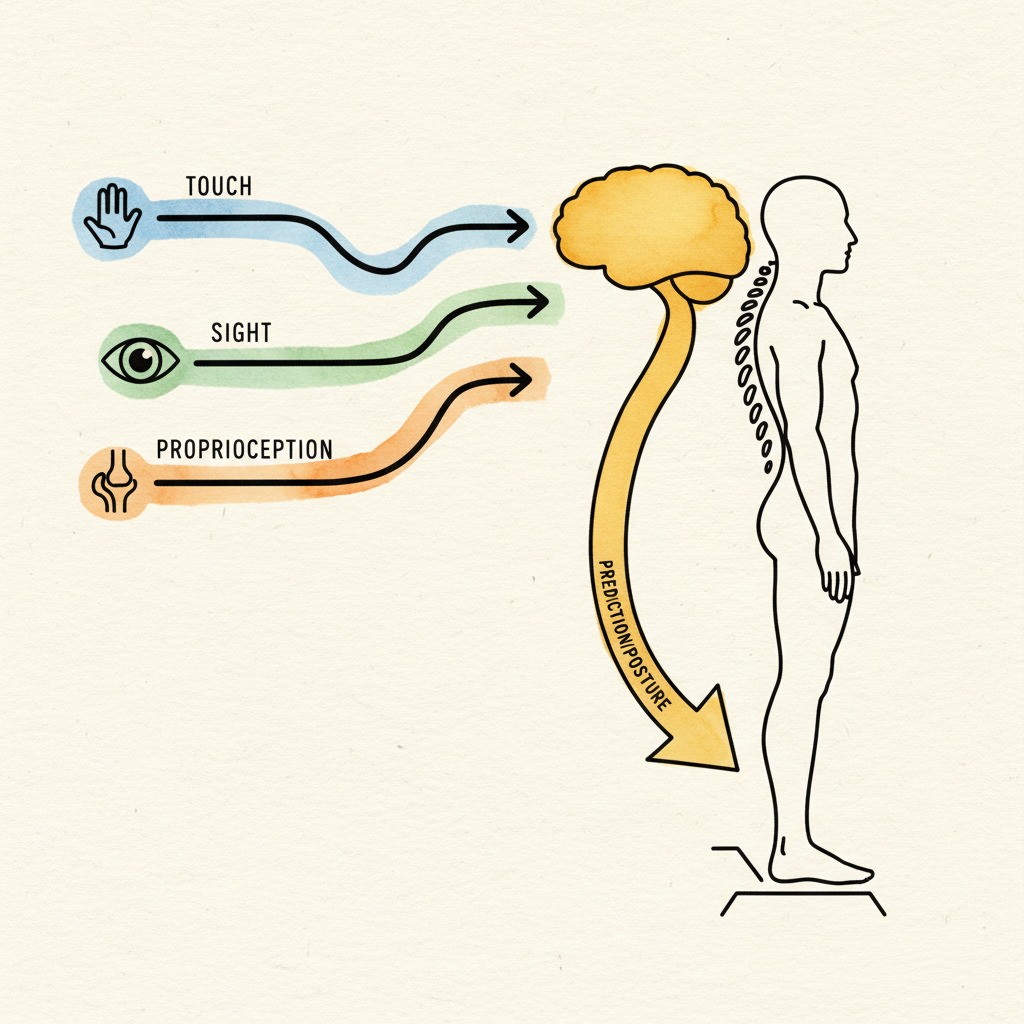
Your nervous system maintains a deep, continuous map of your body in space. Neuroscience calls it the body schema. It lives in the parietal cortex. It is built from sensory data: what your eyes report, what your jaw senses, what your feet feel against the ground, what your inner ear detects about balance, what your diaphragm does with each breath.
The body schema is not a static image. It is a prediction, continuously updated by sensory input. Posture is the physical expression of this prediction. When the prediction is accurate, the body organizes efficiently. When the prediction is distorted, the body compensates.
The body schema does not take instructions. You cannot tell it to update. It updates only when it receives sensory evidence that contradicts its current model. Not cognitive evidence. Felt evidence. The kind that arrives through the body’s own channels: vision, touch, pressure, proprioception, breath.
“Sit up straight” has never permanently changed anyone’s posture. The instruction lands at the motor cortex, the executor. The prediction lives upstream, in the parietal cortex, in the body schema. The executor takes orders from the schema. Not the other way around.
Safety first. Not as a preference.
The body schema does not update indiscriminately. It has a gatekeeper. In the thalamus. A filtering mechanism that determines what sensory data reaches the schema and what gets suppressed.
Under threat, the gate closes. The thalamus suppresses sensory input from body regions the system considers non-essential. Pain signals get through. Spatial detail does not.
The body map for affected regions becomes blurred. Neuroscience calls it cortical smudging. You literally cannot feel the detail of your own body in those areas. You cannot correct what you cannot feel. And you cannot feel what the thalamus will not let through.
The first step in any real postural intervention is not an exercise. It is a state shift. Reduce threat. Open the gate. Give the body schema permission to receive new data.
The sensory hierarchy
Not all sensory inputs carry equal weight. There is a hierarchy. The dominant inputs at the top override everything below them, regardless of how well the lower tiers are organized.
Tier 1: Vision and Jaw. These are the two highest-weighted inputs into the postural prediction. Vision, specifically peripheral vision, provides the primary spatial reference. When it degrades, the brain drives the head forward and the posterior chain braces. The jaw, through the trigeminal nerve’s direct connection to cervical motor neurons, provides continuous data about head-on-body position.
Tier 2: The Cerebellar Integrator. The cerebellum takes all sensory data and builds the prediction. Head position is its primary output. Everything below the skull organizes around what the cerebellum predicts the head needs to do.
Tier 3: Diaphragm, Hip Joints, Ground Contact. Powerful but subordinate inputs. The diaphragm is the single most important intervention lever available without specialist referral. It simultaneously touches pressure mechanics, fascial coordination, and vagal tone. No other structure has that triple convergence. But it cannot override corrupted data from vision and jaw above it.
This is the ceiling many people hit. They do excellent breathwork and still cannot hold their posture. The rate-limiting variable is upstream.
How the prediction becomes a pattern
The body schema consolidates over time. Every day you spend in a compensatory pattern, the model treats it as additional evidence that this is where the body belongs. The prediction becomes more entrenched. The muscles adapt. The fascia remodels along the lines of tension. The proprioceptive set points recalibrate.
Screen time narrows the visual field. Shoe-wearing deadens ground contact. Shallow breathing collapses internal pressure. Jaw clenching corrupts cervical data. Each input is small. The cumulative effect is a body schema that increasingly believes the compensatory pattern is correct.
The compensatory pattern has a name: systemic extension. Forward head. Elevated chest. Anterior pelvic tilt. Hyperextended knees. Tight calves. One pattern, generated by one prediction, driven by degraded sensory data and a system manufacturing stability from rigidity because it cannot find it through sensation.
Internal pressure: the Dragon
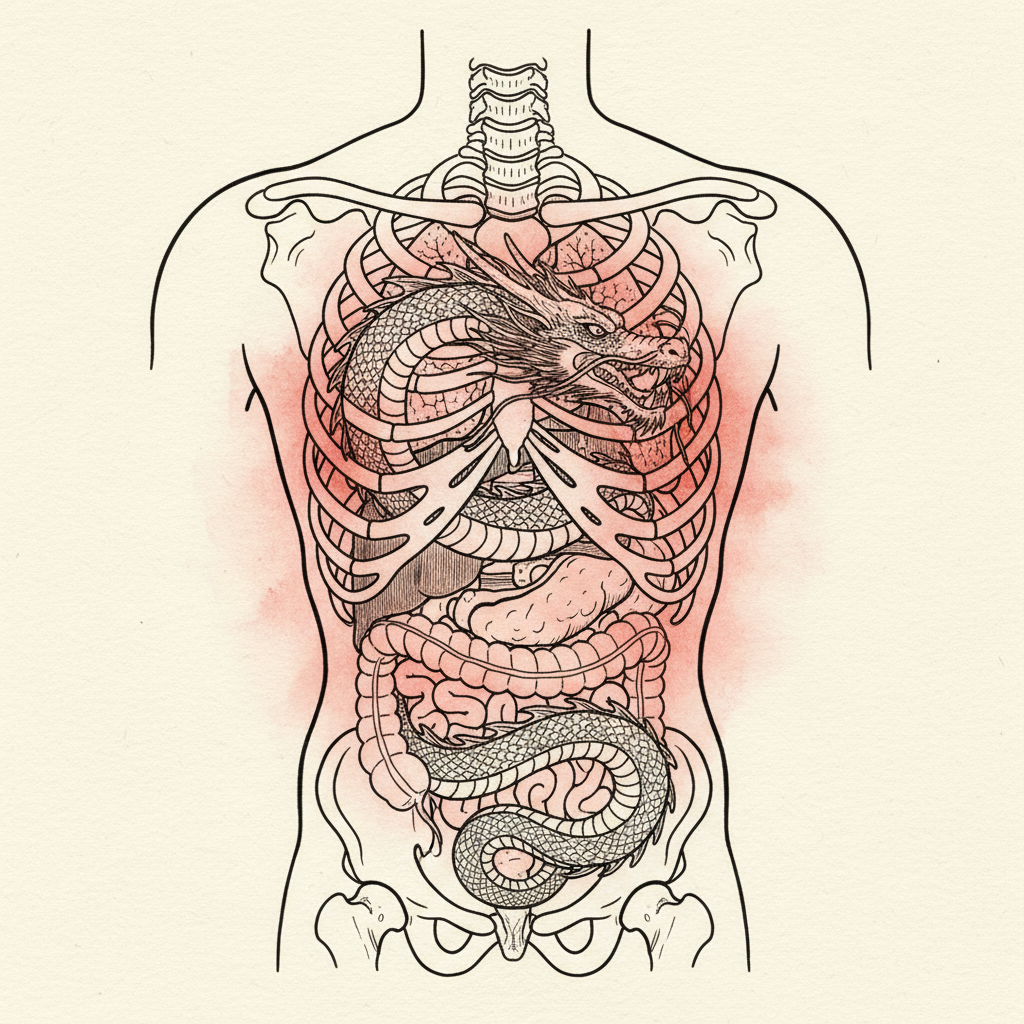
The body is not a stack of bones. It is a pressure system. The abdominal cavity is a sealed, hydraulic chamber. Diaphragm at the top. Pelvic floor at the bottom. Abdominal wall and spine as the boundary. When the diaphragm descends properly during breathing, it pressurizes this chamber. That pressure stabilizes the spine from inside.
When this pressure is well-organized, it propagates through the body as a wave. Through the spiral geometry of the spine, through the diagonal fascial slings, from pelvis to shoulders and back. The pressure does not travel in a straight line. It spirals. Because the body is curved, asymmetric, and organized in helical patterns.
Every culture that developed sustained internal practice described this. A serpent. A dragon. Kundalini. Qi. They were feeling the same phenomenon from the inside. A pressure wave traveling through a hydraulic tensegrity system. The description was pre-scientific. The observation was accurate.
Sharon, one of our cohort participants, described what it felt like when the pressure started organizing: “I definitely am starting to notice the bowl filling out the pelvic area with my breath. Leading to all the other emotions and breaths feeling more grounded.”
That is what it feels like when the internal scaffolding comes back online.
How to update the prediction
The sequence is not optional. It is architecturally determined by the nervous system’s own structure.
Safety first. Reduce the threat level. Slow the breath. Shift from sympathetic dominance toward parasympathetic access. The thalamic gate must open before sensory data can reach the body schema. Without safety, no update is possible.
Sensory second. Restore the inputs. Ground contact through the feet. Peripheral visual engagement. Jaw awareness. Diaphragmatic breathing that generates internal pressure. These are not exercises. They are sensory nutrition. You are feeding the body schema the data it needs to build an accurate prediction.
Motor third. Now, and only now, movement patterns. Strengthening. Mobilization. The corrective exercises that conventional programs start with. In this sequence, they work. Because the system receiving them can actually integrate them.
Most programs start at motor. They skip safety and sensory entirely. The exercises override the prediction. The prediction reasserts. The person blames themselves for not trying hard enough. The sequence was backwards from the beginning.
The evidence your body accepts
Your posture is not a discipline problem. It is not a strength problem. It is a prediction running in your nervous system, generated by sensory data you have never examined, maintained by a body schema you did not know existed, gated by a threat assessment you cannot consciously override.
The prediction can change. The body schema can update. The posture that emerges from that update does not require effort to maintain. It runs automatically, like the old pattern did. But organized instead of compensatory.
Your body does not take instructions. It takes evidence. Change the evidence, and the prediction rewrites itself.
Sam Miller is the founder of Posture Dojo. He carries an 85-degree S-curve and builds everything he teaches from the inside of that experience.
Leave a Reply